20 Minute Leaders, episode 530: deep work, people and mistakes
Topics: Engineering leadershipEngineering talent and educationEntrepreneurship
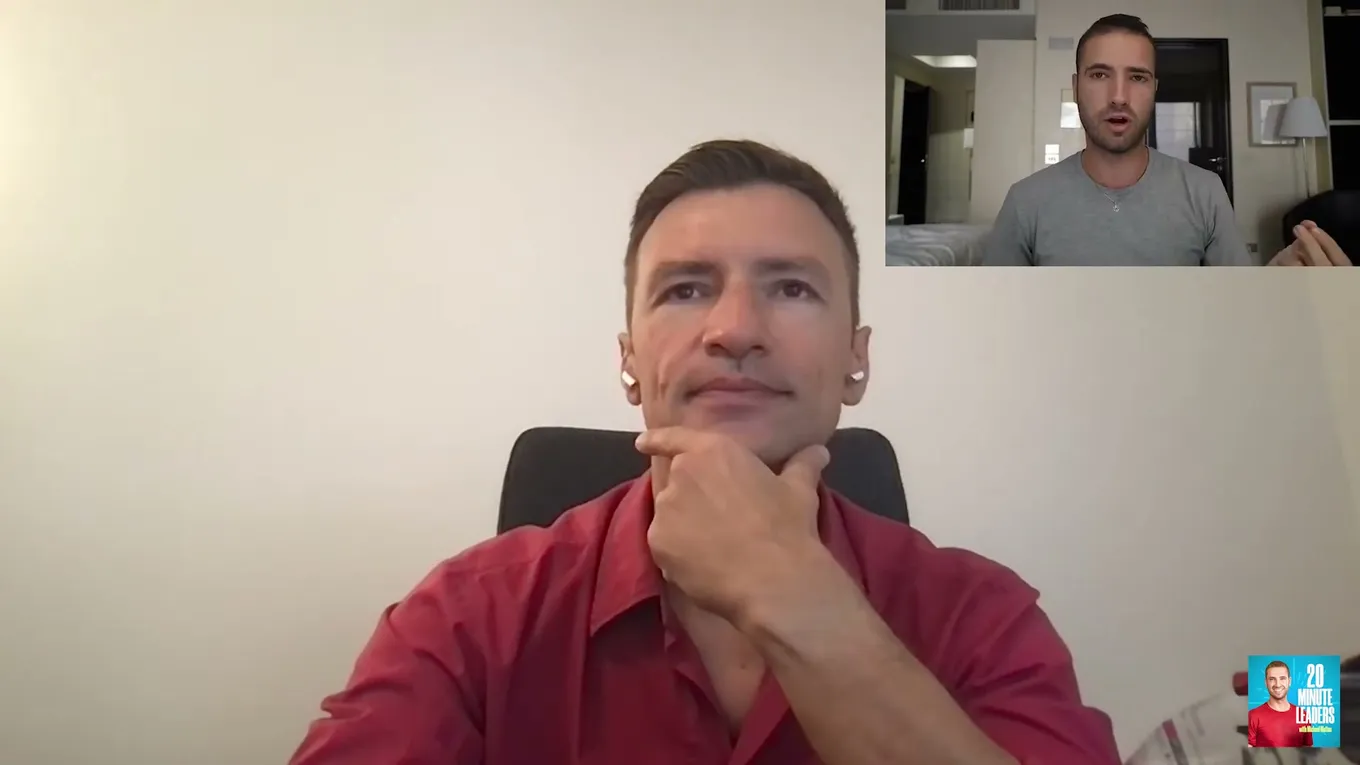
Watch the episode on YouTube ↗Ep530: Marius Hanganu | Managing Partner, Tremend
Episode 530 of 20 Minute Leaders, August 2021, about 22 minutes. I was then co-founder and managing partner of Tremend. Topics: deep work instead of part-time, software as a people business, admitting mistakes to clients, Romania as a destination for software development, and the move from technical problems to people and groups.
Deep work, not part-time
“I don’t believe in part-time. I’m not a fan of part-time.” 3:28
Attention: “whenever your attention is split in multiple ways, I think you aren’t achieving your best, you aren’t exploring the depth of the domain deep enough” (4:31). The comparison: “it would be like doing yoga or meditation, but listening to music at the same time” (5:54). My example: a national basketball championship, then the choice of the “deep dive” on my IT career (6:58). Deep work is one of the three words I chose for myself: “I can lose myself in working on one topic” (21:34).
Elsewhere. April 2026, on what breaks that immersion when working with AI agents: Flow is broken.
Most businesses are people businesses
“Most businesses are people businesses, not just the professional service sector like ourselves.” 14:15
One pillar of Tremend’s growth: hiring people, not only technical experts, because “if you spend too much time with the code and the screen, that’s where your skills are” (14:57). The result, “a bit of a snowball effect” (15:18): colleagues said the team was great, which attracted more people, and clients said “these guys are good and it’s also nice to interact with them” (15:39).
Elsewhere.
- Recorder, 2018 headline: to be a good programmer, you have to take your nose out of the computer and see what is happening around you.
- Publicis Sapient, 2024: “if you spend your time with the machine rather than human, of course you learn the way of the machine rather than learning the way of the human.”
Admitting the mistake
Ray Dalio’s Principles and radical transparency have “a lot of overlap” with Tremend’s culture (16:20):
“Admitting to the mistake, trying to fix and having a positive attitude instead of masking the error, tricking the customer.” 16:20
Everybody makes mistakes; a team that admits and fixes them is pleasant to work with (16:42).
Elsewhere. Economica.net, 2022, a lesson for founders: “I would stress the importance of being open to mistakes, the opposite of how we were taught. Making mistakes has positive sides.” („aș accentua importanța de a fi deschiși față de greșeli, opusul felului în care am fost noi învățați. A greși are valențe pozitive”)
Why Romania became a destination for software development
Three reasons (11:10): an education system focused on mathematics and the exact sciences, Romania being “probably the largest country in the region”, and a culture that looks at Western models. For a buyer choosing where to build software, “this cultural factor is a pretty strong one in favor of Romania” (12:53).
Elsewhere. Business Magazin, 2017: compared with Western Europe, Romania stands out through a good ratio between the quality and the productivity of its programmers, their adaptability, their interest in new technologies and their versatility across programming languages.
From technical problems to people
“Any technical problem can be solved with enough time.” 20:34
My focus moved from technical problems to “trying to understand how the mind of my colleagues work and how the mind of a social group works”, because a group follows rules similar to one person’s but also has its own (20:54).
Elsewhere.
- Recorder, 2018: “at some point we realised that, to be able to grow, you also have to be a good manager.” („la un moment dat, ne-am dat seama că, pentru a putea creşte, trebuie să fii şi un manager bun”)
- August 2026, guiding AI agents as leading an organisation: Agent guidance reads like a CEO’s messaging to their org.
Watch the episode on YouTube ↗
A summary of an external interview or article. Quotes are my words as published or spoken; the original is the reference.