Publicis Sapient, Transforming with Empathy: AI adoption, ChatGPT and the psychology of change
Topics: Enterprise AI adoptionPsychology of work with AI
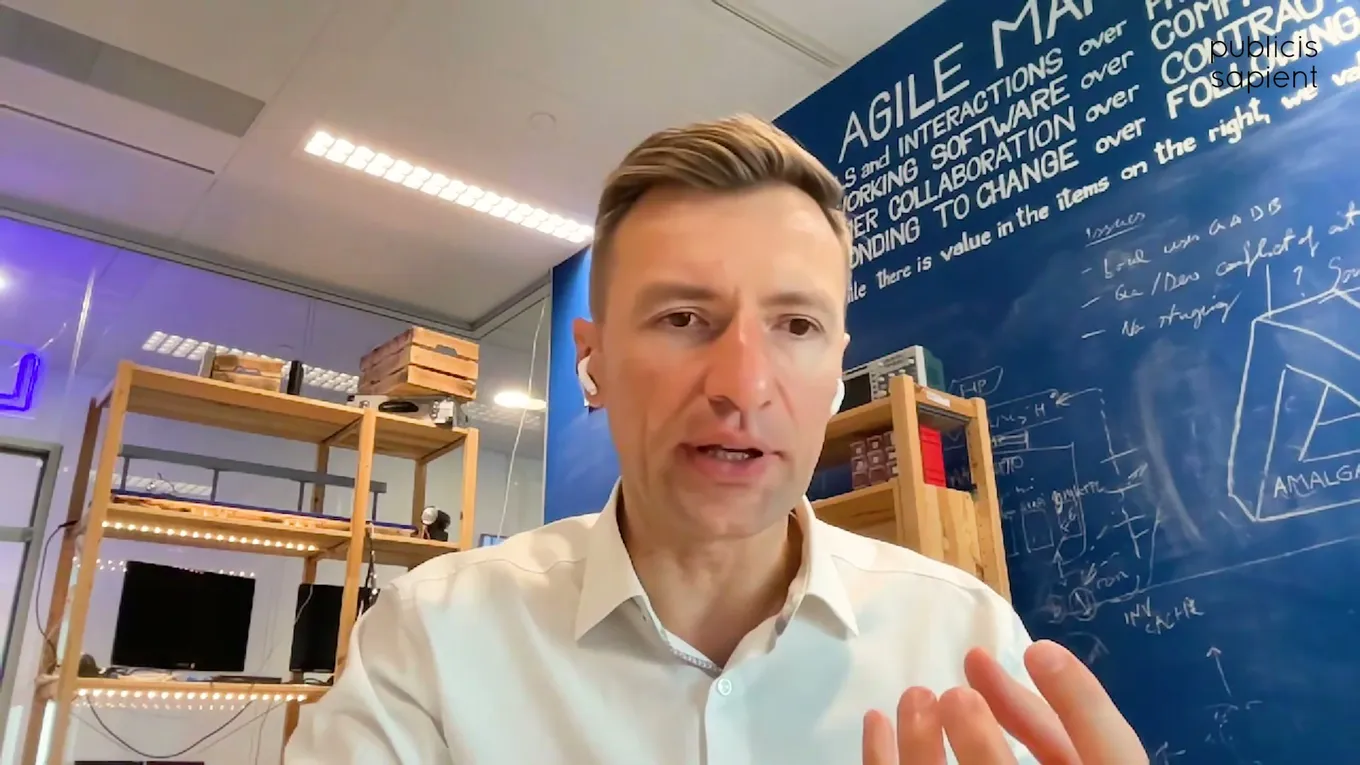
Watch the episode on YouTube ↗Transforming with Empathy: Insights from Marius Hanganu
Transforming with Empathy, a Publicis Sapient video interview, February 2024, about seven minutes. I spoke as co-founder of Tremend. The host introduces Tremend as a company founded in 2005 that grew to 650 people before it was acquired, and my background as “this mix of technical knowledge of architectures and so on but also delivery” (1:20). Topics: the finite energy people have during change, ChatGPT, where empathy for clients comes from, the psychology of change, and how engineers learn the human side of their work.
Finite energy, careful change
“As humans we have a finite amount of energy, right, so we have to be careful where we spend that energy.” 1:38
The question: bringing the culture of the company I co-founded into a larger one. The example: a person who has to execute a task while dealing at the same time with “five organizational changes” and a new location for certain files (1:51).
Elsewhere. 20 Minute Leaders, 2021, on attention: “whenever your attention is split in multiple ways, I think you aren’t achieving your best, you aren’t exploring the depth of the domain deep enough.”
ChatGPT as an instant boost
“The instant you don’t know something, you get a boost, a kicker, something that jumps you from zero to one.” 2:13
Part of that workload during change “is facilitated by ChatGPT” (2:09). A jump that used to take days and weeks now takes minutes (2:25).
Empathy from constant transformation
“The empathy that not just myself but I guess any colleague will feel towards a client in terms of the struggle to use a new system, change some process.” 3:02
The question: what my own experience of transformation, as a founder and then inside a larger company, brings to client work. Digital companies go through “quite dynamic and continuous transformation” themselves. Seeing clients in other industries struggle to adopt a new platform, “you become more empathetic, you become more close to their feeling” (3:43). From there, “you actually start building amazing experiences, amazing customer experience” (3:52).
The psychology of change
“A more structured way of approaching this would be really understanding the psychology of change.” 4:58
This usually goes hand in hand with knowing a bit about hormones, dopamine and the mechanisms described in neuroscience. The comparison: an engineer who understands what a piece of code does. Once you understand the underlying way of functioning, “it then somehow becomes much simpler” (5:29). Change is then “not just a blunt deployment of small tricks and, like, smoke and mirrors here and there to trick the user into following this digital business transformation path”, but a more solid way of working with groups of people as they adopt and change (5:35).
Elsewhere. 20 Minute Leaders, 2021, on moving from technical problems to people: “trying to understand how the mind of my colleagues work and how the mind of a social group works.”
The way of the machine
“If you spend your time with the machine rather than human, of course you learn the way of the machine rather than learning the way of the human.” 6:51
On engineers becoming more empathetic in their work: “the short answer is that it’s just a matter of practice” (6:28). You have to expose yourself to the experience to become familiar with it. The comparison: a salesperson, whose work is all about interacting with people and understanding how things run, against someone who spends the same time looking at a piece of code and finding a creative solution to make it work (7:01). “It’s a matter of practice. I think everybody has it” (7:22).
Elsewhere. 20 Minute Leaders, 2021, on hiring at Tremend: “if you spend too much time with the code and the screen, that’s where your skills are.”
Watch the episode on YouTube ↗
A summary of an external interview or article. Quotes are my words as published or spoken; the original is the reference.